Choose a camera angle
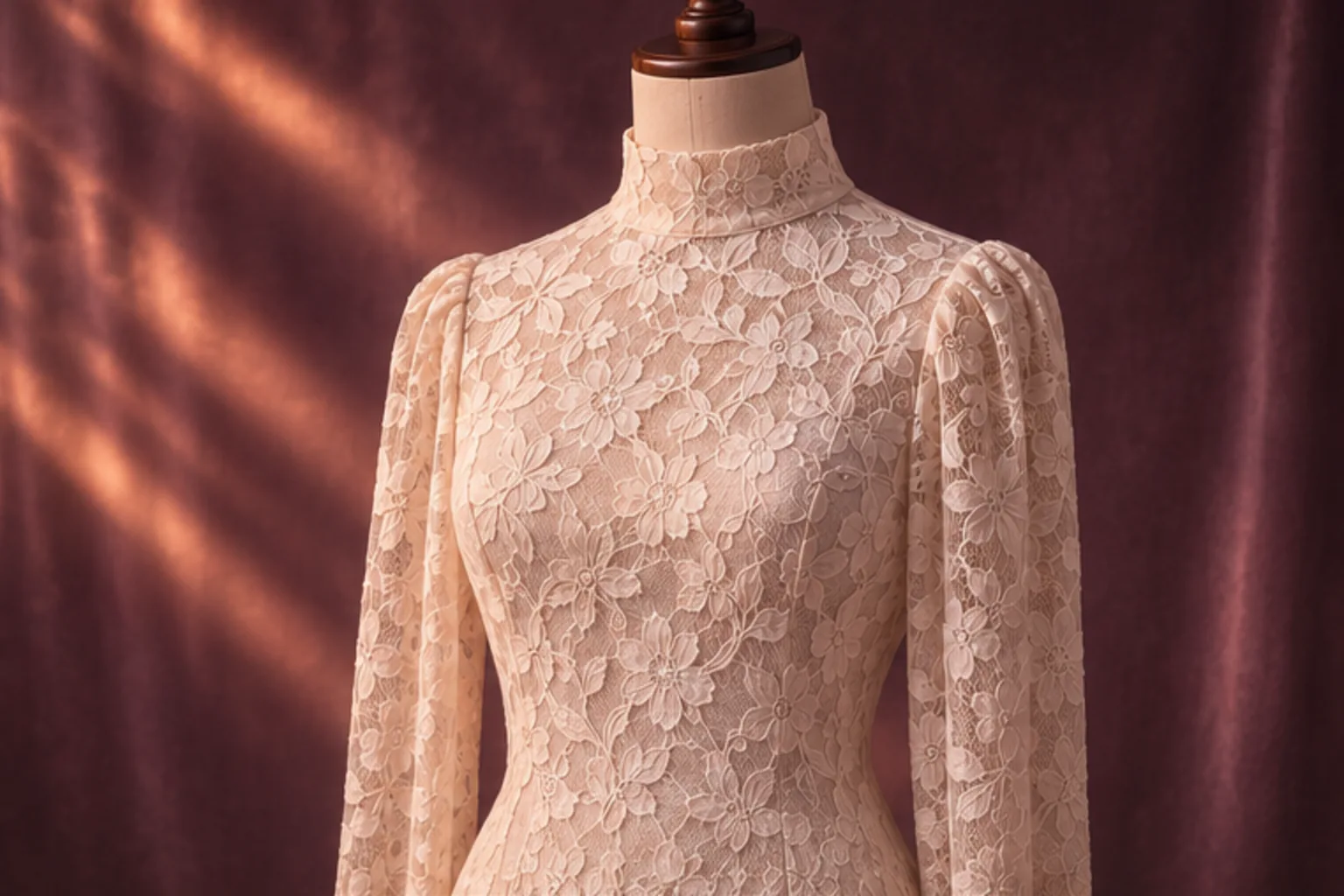
Use a garment-level view to show where the lace panels sit and a closer angle when the motif itself matters. On a high-neck blouse, keep part of the collar and one seam in the crop so the viewer can place the textile. A tailoring mannequin or a fabric swatch is useful for the first pass. For a comparison sheet, choose a straight-on view and use the same distance to the fabric on each take.
Describe the details you want to keep
Name the motif, its scale and the fabric beneath it. Small ivory flowers over a matching opaque lining produce a different design from large geometric lace over a contrasting fabric. Indicate where the lace stops, such as at a piped collar or a seam panel. Broad side light reveals the raised edges without making the holes look like extra dark embroidery. Colours that are close in value make the motif subtler and are easier to compare under the same light.
What to check in the result
Check that the pattern repeats at a consistent size and respects the shape of the garment. A motif should stop or fold at a seam rather than continue across empty space. If the weave looks noisy, enlarge the motif slightly and simplify the lighting. To judge how it reads, look at a thumbnail first, then zoom into the collar or cuff. If you intend to sew the garment, use the image as a reference for appearance and confirm the construction with a pattern or sample.
A starting prompt
Fashion textile photograph of small ivory floral lace on an opaque lined high-neck blouse displayed on a tailoring mannequin, a clean collar edge and one visible shoulder seam, soft raking light from a window, muted violet studio.
Change one detail at a time
Try one small floral repeat and one larger repeat on the same lined blouse. Keep the collar, mannequin, lining colour and window light unchanged. Compare the two thumbnails first to see which pattern registers at a normal viewing distance. Then zoom in to check whether the raised stitches still follow the weave near the shoulder seam. Keep the camera and light consistent when you want to compare two designs.
Questions
- Can I use a reference image?
- Yes, when you switch to a model that accepts an image input. Use an image you have permission to use. For photos of people, use your own photo or one of a consenting adult whose age is clear. A reference can guide a pose or garment shape, but the result can still vary.